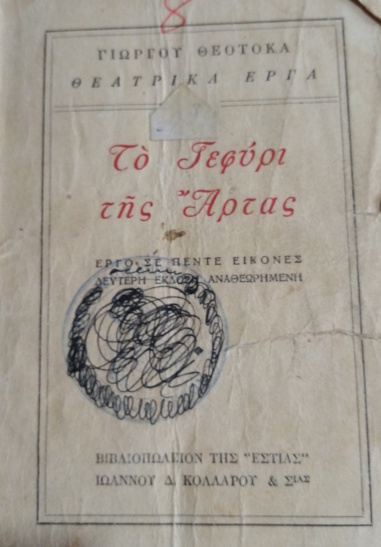
On August 11, 1969, THEATRE LONGOS presented the play
"THE BRIDGE OF ARTA"
"The Bridge of Arta" (Το γεφύρι της Άρτας) is a play by GEORGIOS THEOTOKAS.
|
|
On August 11, 1969, THEATRE LONGOS presented the play"THE BRIDGE OF ARTA""The Bridge of Arta" (Το γεφύρι της Άρτας) is a play by GEORGIOS THEOTOKAS.
|
|
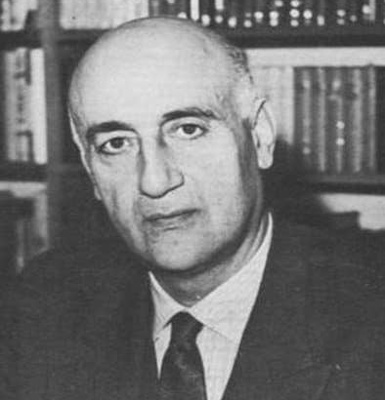
Greek writer and lawyer Georgios Theotokas was born in Constantinople on August 27, 1905. He was one of the representatives and leading intellectuals of the generation of the 1930s, and perhaps its most multifaceted member.
|
|
The family roots of Theotokas His parents, Androniki and Michalis, were from Chios. The earliest references to the Theotokas family date back to the 17th century in house sale deeds. His grandfather Georgios was a village elder and had a brother, Konstantinos, who became a priest and was named Germanos, eventually becoming Metropolitan of Leros and Kalymnos. His father was Michalis Theotokas (1872-1951), who, after studying law in Athens, settled in Constantinople and married Androniki Nomikou, the daughter of a merchant from Neneta, Chios, who had settled in Constantinople. They had two children, George and Maria-Elena. Life Georgios Theotokas studied at the Zamaria School from 1911 to 1913 and then at the National Greek-French Lyceum, where he remained until 1922. After the Asia Minor catastrophe in 1922, the Theotokas family settled in Athens. In the capital, Theotokas studied at the Law School of the University of Athens, enrolling in 1922 and graduating on November 26, 1926. In January 1927, he left for Paris to pursue independent studies in law, history, and philosophy. In 1928, he moved from Paris to London, where he studied English law and English literature and attended courses in history and culture. He returned to Athens shortly thereafter, in the autumn of 1929, and worked as a lawyer. At the same time, he was very active in the intellectual sphere: in 1929, he published his essay Free Spirit, which was later described as the "manifesto" of the Generation of the 1930s, and collaborated with literary magazines, while in 1933 he published his first literary work, the first part of the novel Argo. The Academy of Athens awarded him the "prose prize" in 1939 for his novel The Demon. However, his work was temporarily interrupted due to the Greco-Italian War of 1940: on November 22, 1940, he volunteered at Goudi but was refused enlistment. On December 3, 1940, he enlisted in Empedos and on January 17, 1941, he was discharged. In February 1941, he was re-enlisted in the 12th Company of the GEA, where he would be trained in mortars. In October 1944, he met Georgios Papandreou, who asked him to take on any public position he desired. Although he ultimately did not take the position, Theotokas wrote a memorandum on the state of mind in Athens in the autumn of 1944. On May 10, 1948, he married Byzantinologist Nafsika Stergiou in Thessaloniki. He served as director of the National Theatre during the periods: February 16, 1945-May 10, 1946 (dismissed by the Tsaldaris government), and 1952-1953. Georgios Theotokas was also involved in politics: in 1956, he was a candidate for the Democratic Union in his hometown of Chios, but failed to secure election. In the May 1958 elections, he offered his public support to the Liberal Party, without running for office again. From August 1952 to early February 1953, he traveled to the United States. The reason for his trip was an invitation from the State Department, which, through the Smith-Mundt educational exchange program, aimed to improve the image of the United States in the context of the Cold War. His selection was also related to his position as director of the National Theater. In 1960, he visited Egypt, Mount Sinai, and Mount Athos. In 1961, he traveled to Lebanon and Syria, and in 1962 to Romania, the Soviet Union, and Persia. In December 1962, he visited the USSR as a member of a group of Greek intellectuals who had been invited as part of Cold War propaganda: he visited Odessa, Moscow, and Leningrad. In September 1963, he participated with Evangelos Papanoutsos in the Education Subcommittee of the Center Union, which drafted a comprehensive plan for the education system in case the Center Union came to power. In 1961, he served as chairman of the first Board of Directors (then the Northern Greece Theater Organization Committee) of the State Theater of Northern Greece. In 1965, he visited Bulgaria. His wife, Nafsika Stergiou, died in July 1959 after an illness that had been diagnosed at the end of 1956. In 1966, he remarried, this time to Koralia Andriadi. He died on October 30, 1966, in Athens, at the age of 61, from liver cancer, which had not been diagnosed in time. The intellectual journey of Georgios Theotokas Theotokas demonstrated his intellectual prowess from his school years onwards. As a student, he gave lectures on the history of demoticism and the work of Dionysios Solomos, foreshadowing his future struggles for demoticism. During his student years, as a member of the Student Association, he published an article on the occasion of Yannis Psycharis' visit to Greece and his hometown of Chios (August 27-29, 1925) an article in the newspaper Nea Chios entitled The social significance of Psycharis' work. He gave a lecture on the same subject and addressed Psycharis at a ceremony in his honor at the Social Sciences Society on November 20, 1925. At the same time, he wrote articles for the newspaper of the same name published by the Student Association, covering topics ranging from language issues and literature to family law. Later, in Paris, he wrote articles for the Kastanakis brothers' newspaper Agon. During this period, he developed the ideas that he would express in Elefthero Pneuma, which he began to work on during the next stage of his studies in London. In 1931, he began collaborating with the magazines Nea Estia and Kyklos. From 1929 to 1931, he also wrote articles for the newspapers Proia and Ergasia. Shortly before that, he attempted to publish the magazine Odysseas together with N. Kalamatis, K. Th. Dimaras, and I. Tsirimokos, but they failed. In January 1932, he published his political beliefs in Empros sto sosialiko problem (Forward to the Social Problem). From January 1933 to May 1934, he wrote articles for the magazine Idea. From 1930 to 1935, he wrote articles for the magazine Nea Grammata. In 1931, he published Hours of Leisure and in 1933, Argo. After the establishment of the Metaxas dictatorship, he ended his collaboration with Nea Grammata and began collaborating with the magazine Neohellenika Grammata. During the 1940s, he turned to theater: Antara st' Anapli (1942), To Gefiri tis Artas (1942), Peftei to Vrady (written in 1941 and published in 1943). The Castle of Oria (1944) and in 1947 The Game of Madness and Prudence. In 1945, he was nominated for the Nobel Prize in Literature by Sigfrid Siwertz, a member of the Swedish Academy.
|