More about THESSALONIKI
Names and etymology
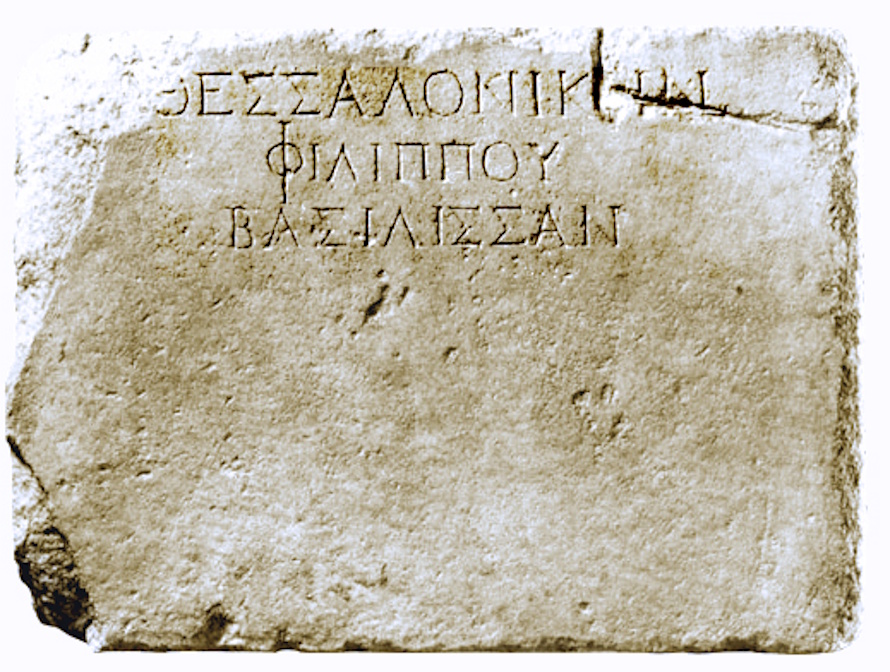
The original name of the city was Θεσσαλονίκη Thessaloníkē. It was named after the princess Thessalonike of Macedon, the half-sister of Alexander the Great, whose name means "Thessalian victory", from Θεσσαλός Thessalos, and Νίκη 'victory' (Nike), honoring the Macedonian victory at the Battle of Crocus Field (353/352 BC).Minor variants are also found, including Θετταλονίκη Thettaloníkē, Θεσσαλονίκεια Thessaloníkeia, Θεσσαλονείκη Thessaloneíkē, and Θεσσαλονικέων Thessalonikéon.
The name Σαλονίκη Saloníki is first attested in Greek in the Chronicle of the Morea (14th century), and is common in folk songs, but it must have originated earlier, as al-Idrisi called it Salunik already in the 12th century. It is the basis for the city's name in other languages: Солѹнъ (Solunŭ) in Old Church Slavonic, סאלוניקו (Saloniko) in Judeo-Spanish (שאלוניקי prior to the 19th century) סלוניקי (Saloniki) in Hebrew, Selanik in Albanian, سلانیك (Selânik) in Ottoman Turkish and Selanik in modern Turkish, Salonicco in Italian, Solun or Солун in the local and neighboring South Slavic languages, Салоники (Saloníki) in Russian, Sãrunã in Aromanian and Săruna in Megleno-Romanian.
In English, the city can be called Thessaloniki, Salonika, Thessalonica, Salonica, Thessalonika, Saloniki, Thessalonike, or Thessalonice. In printed texts, the most common name and spelling until the early 20th century was Thessalonica (/ˌθɛsələˈnaɪkə, ˌθɛsəˈlɒnɪkə/), matching the Latin name; through most of rest of the 20th century, it was Salonika (/səˈlɒnɪkə, ˌsæləˈniːkə/). By about 1985, the most common single name became Thessaloniki. The forms with the Latin ending -a taken together remain more common than those with the phonetic Greek ending -i and much more common than the ancient transliteration -e.
Thessaloniki was revived as the city's official name in 1912, when it joined the Kingdom of Greece during the Balkan Wars. In local speech, the city's name is typically pronounced with a dark and deep L, characteristic of the accent of the modern Macedonian dialect of Greek. The name is often abbreviated as Θεσ/νίκη.
 |
 |
Left: Inscription reading "To Queen Thessalonike, (Daughter) of Philip", Archaeological Museum of Thessaloniki
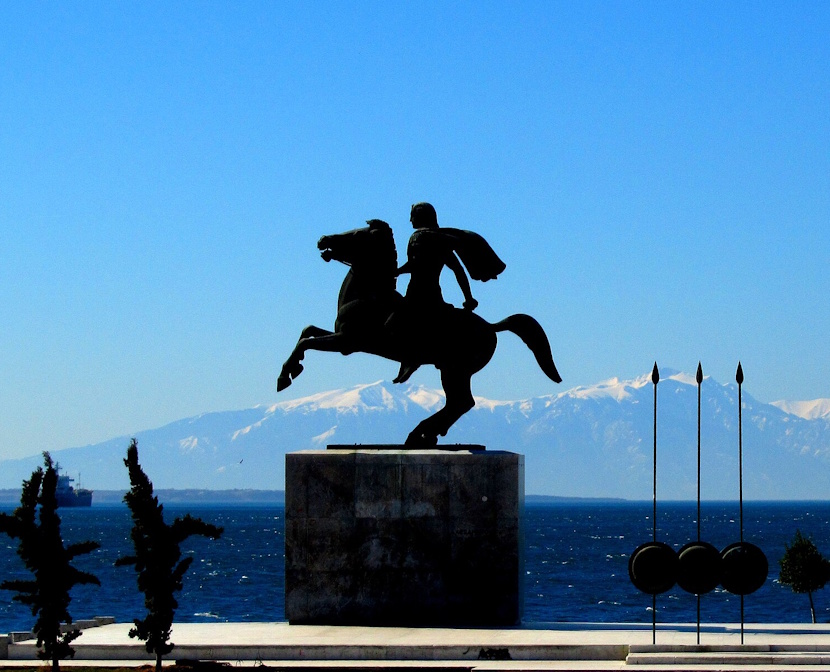
Right: The equestrian statue of Alexander the Great on the promenade
History
From classical antiquity to the Roman Empire The city was founded around 315 BC by the King Cassander of Macedon, on or near the site of the ancient town of Therma and 26 other local villages. He named it after his wife Thessalonike, a half-sister of Alexander the Great and princess of Macedonia as daughter of Philip II. Under the kingdom of Macedonia the city retained its own autonomy and parliament and evolved to become the most important city in Macedonia. Nonetheless, Pella remained the capital of Macedon until its fall.
Twenty years after the fall of the Kingdom of Macedonia, in 148 BC, Thessalonica was made the capital of the Roman province of Macedonia. Thessalonica became a free city of the Roman Republic under Mark Antony in 41 BC. It grew to be an important trade hub located on the Via Egnatia, the road connecting Dyrrhachium with Byzantium, which facilitated trade between Thessaloniki and great centres of commerce such as Rome and Byzantium. Thessaloniki also lies at the southern end of the main north–south route through the Balkans along the valleys of the Morava and Axios river valleys, thereby linking the Balkans with the rest of Greece. The city became the capital of one of the four Roman districts of Macedonia.
At the time of the Roman Empire, about 50 AD, Thessaloniki was also one of the early centres of Christianity; while on his second missionary journey, Paul the Apostle visited this city's chief synagogue on three Sabbaths and sowed the seeds for Thessaloniki's first Christian church. Later, Paul wrote letters to the new church at Thessaloniki, with two letters to the church under his name appearing in the Biblical canon as First and Second Thessalonians. Some scholars hold that the First Epistle to the Thessalonians is the first written book of the New Testament
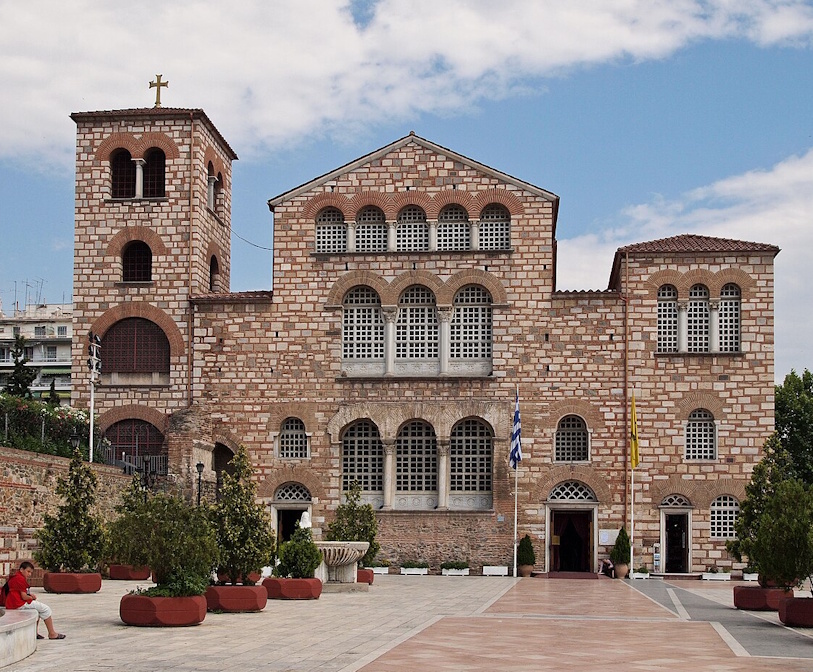
In 306 AD, Thessaloniki acquired a patron saint, St. Demetrius, a Christian whom Galerius is said to have put to death. Most scholars agree with Hippolyte Delehaye's theory that Demetrius was not a Thessaloniki native, but his veneration was transferred to Thessaloniki when it replaced Sirmium as the main military base in the Balkans. A basilical church dedicated to St. Demetrius, Hagios Demetrios, was first built in the fifth century AD and is now a UNESCO World Heritage Site.
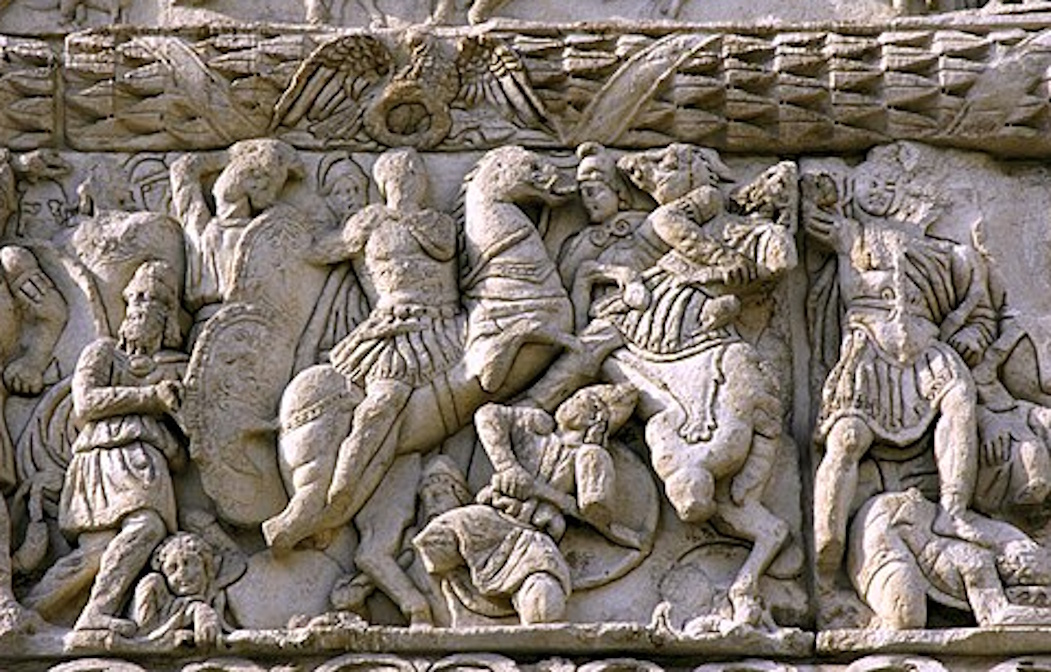
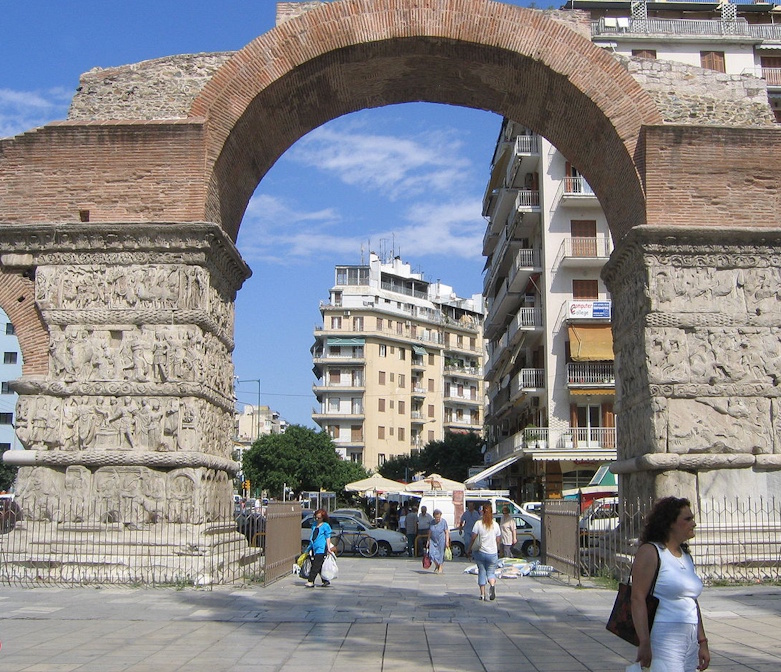
When the Roman Empire was divided into the tetrarchy, Thessaloniki became the administrative capital of one of the four portions of the Empire under Galerius Maximianus Caesar, where Galerius commissioned an imperial palace, a new hippodrome, a triumphal arch and a mausoleum, among other structures.
Thessaloniki remained the administrative center of the Diocese of Macedonia. In 379, when the Roman Prefecture of Illyricum was divided between the East and West Roman Empires, Thessaloniki became the capital of the new Prefecture of Illyricum. The following year, the Edict of Thessalonica made Christianity the state religion of the Roman Empire. In 390, troops under the Roman Emperor Theodosius I led a massacre against the inhabitants of Thessalonica, who had risen in revolt against the detention of a favorite charioteer. By the time of the Fall of Rome in 476, Thessaloniki was the second-largest city of the Eastern Roman Empire.
 |
 |
Left: Detailed view of the Arch of Galerius
Right: The Arch of Galerius, known as Kamara, in the center of Thessaloniki
 |
 |
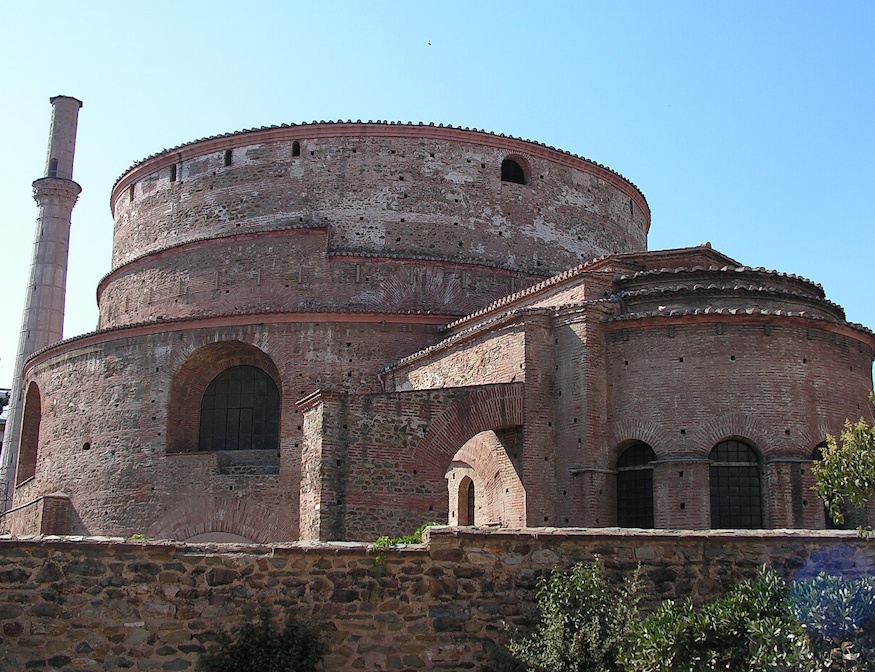
Left: The fourth-century AD Rotunda of Galerius, one of several Roman monuments in the city and a UNESCO World Heritage Site.
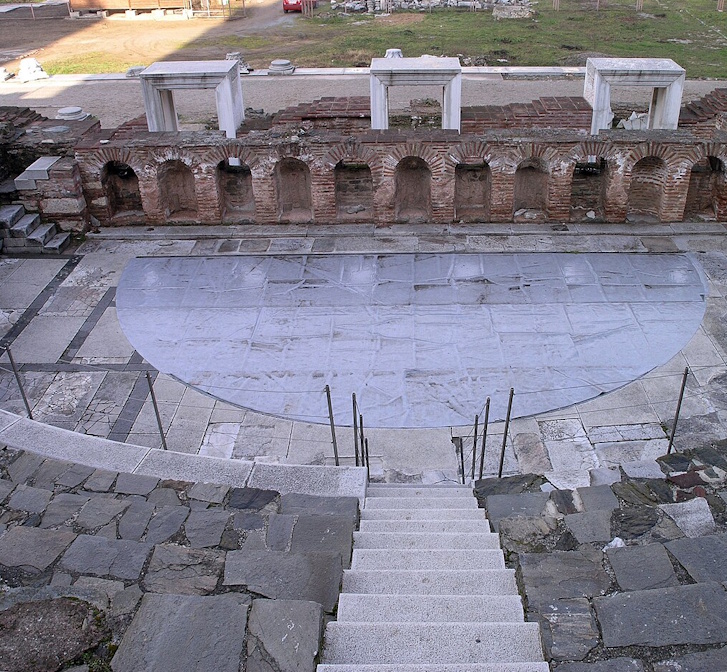
Right: View of the Roman Odeon in the Roman marketplace of Thessaloniki.
Byzantine era and Middle Ages
From the first years of the Byzantine Empire, Thessaloniki was considered the second city in the Empire after Constantinople, both in terms of wealth and size, with a population of 150,000 in the mid-12th century. The city held this status until its transfer to Venetian control in 1423. In the 14th century, the city's population exceeded 100,000 to 150,000, making it larger than London at the time.During the sixth and seventh centuries, the area around Thessaloniki was invaded by Avars and Slavs, who unsuccessfully laid siege to the city several times, as narrated in the Miracles of Saint Demetrius. The written sources stipulate that many Slavs settled in the hinterland of Thessaloniki which became known as 'Macedonian Sclavinia'. In the ninth century, the Byzantine missionaries Cyril and Methodius, both natives of the city, created the first literary language of the Slavs, the Old Church Slavonic, most likely based on the Slavic dialect used in the hinterland of their hometown.
A naval attack led by Byzantine converts to Islam (including Leo of Tripoli) in 904 resulted in the sack of the city.
The economic expansion of the city continued through the 12th century as the rule of the Komnenoi emperors expanded Byzantine control to the north. The city was sacked again in 1185 by Normans from the Kingdom of Sicily.
Thessaloniki passed out of Byzantine hands in 1204, when Constantinople was captured by the forces of the Fourth Crusade and incorporated the city and its surrounding territories in the Kingdom of Thessalonica — which then became the largest vassal of the Latin Empire. In 1224, the Kingdom of Thessalonica was overrun by the Despotate of Epirus, a remnant of the former Byzantine Empire, under Theodore Komnenos Doukas who crowned himself Emperor, and the city became the capital of the short-lived Empire of Thessalonica. Following his defeat at Klokotnitsa however in 1230, the Empire of Thessalonica became a vassal state of the Second Bulgarian Empire until it was recovered again in 1246, this time by the Nicaean Empire.
In 1342, the city saw the rise of the Commune of the Zealots, an anti-aristocratic party formed of sailors and the poor, which is nowadays described as social-revolutionary. The city was practically independent of the rest of the Empire, as it had its own government, a form of republic. The zealot movement was overthrown in 1350 and the city was reunited with the rest of the Empire.
 |
 |
Left: Church of Saint Demetrius
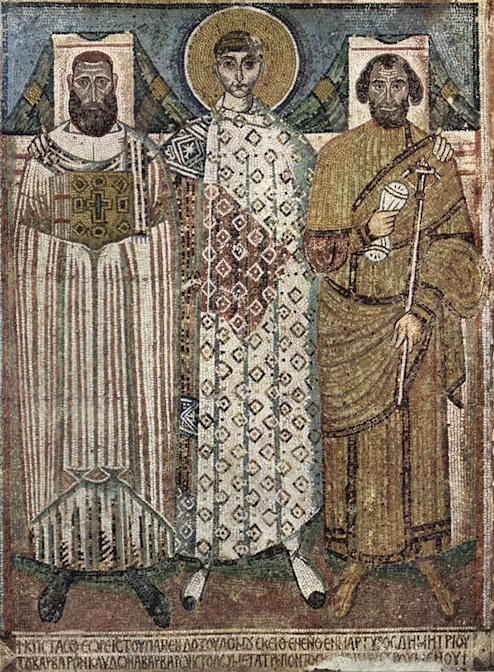
Right: A mosaic of Saint George in Saint Demetrios Church
The capture of Gallipoli by the Ottomans in 1354 kicked off a rapid Turkish expansion in the southern Balkans, conducted both by the Ottomans themselves and by semi-independent Turkish ghazi warrior-bands. By 1369, the Ottomans were able to conquer Adrianople (modern Edirne), which became their new capital until 1453. Thessalonica, ruled by Manuel II Palaiologos (r. 1391–1425) itself surrendered after a lengthy siege in 1383–1387, along with most of eastern and central Macedonia, to the forces of Sultan Murad I. Initially, the surrendered cities were allowed complete autonomy in exchange for payment of the kharaj poll-tax. Following the death of Emperor John V Palaiologos in 1391, however, Manuel II escaped Ottoman custody and went to Constantinople, where he was crowned emperor, succeeding his father. This angered Sultan Bayezid I, who laid waste to the remaining Byzantine territories, and then turned on Chrysopolis, which was captured by storm and largely destroyed. Thessalonica too submitted again to Ottoman rule at this time, possibly after brief resistance, but was treated more leniently: although the city was brought under full Ottoman control, the Christian population and the Church retained most of their possessions, and the city retained its institutions.
Thessalonica remained in Ottoman hands until 1403, when Emperor Manuel II sided with Bayezid's eldest son Süleyman in the Ottoman succession struggle that broke out following the crushing defeat and capture of Bayezid at the Battle of Ankara against Tamerlane in 1402. In exchange for his support, in the Treaty of Gallipoli the Byzantine emperor secured the return of Thessalonica, part of its hinterland, the Chalcidice peninsula, and the coastal region between the rivers Strymon and Pineios. Thessalonica and the surrounding region were given as an autonomous appanage to John VII Palaiologos. After his death in 1408, he was succeeded by Manuel's third son, the Despot Andronikos Palaiologos, who was supervised by Demetrios Leontares until 1415.
Thessalonica enjoyed a period of relative peace and prosperity after 1403, as the Turks were preoccupied with their own civil war, but was attacked by the rival Ottoman pretenders in 1412 (by Musa Çelebi) and 1416 (during the uprising of Mustafa Çelebi against Mehmed I). Once the Ottoman civil war ended, the Turkish pressure on the city began to increase again. Just as during the 1383–1387 siege, this led to a sharp division of opinion within the city between factions supporting resistance, if necessary with Western help, or submission to the Ottomans.
In 1423, Despot Andronikos Palaiologos ceded it to the Republic of Venice with the hope that it could be protected from the Ottomans who were besieging the city. The Venetians held Thessaloniki until it was captured by the Ottoman Sultan Murad II on 29 March 1430. Thus began 500 years of Ottoman Turkish rule in Thessaloniki/Selânik, which would profoundly shape the city's unique multicultural character and urban architecture.
Ottoman period
When Sultan Murad II captured Thessaloniki and sacked it in 1430, contemporary reports estimated that about one-fifth of the city's population was enslaved. Ottoman artillery was used to secure the city's capture and bypass its double walls. Upon the conquest of Thessaloniki, some of its inhabitants escaped, including intellectuals such as Theodorus Gaza "Thessalonicensis" and Andronicus Callistus. However, the change of sovereignty from the Byzantine Empire to the Ottoman one did not affect the city's prestige as a major imperial city and trading hub. Thessaloniki and Smyrna, although smaller in size than Constantinople, were the Ottoman Empire's most important trading hubs. Thessaloniki's importance was mostly in the field of shipping, but also in manufacturing, while most of the city's tradespeople were Jewish.During the Ottoman period, the city's population of Ottoman Muslims (including those of Turkish origin, as well as Albanian Muslim, Bulgarian Muslim, especially the Pomaks and Greek Muslim of convert origin) and Muslim Roma like the Sepečides Romani grew substantially. According to the 1478 census Selânik (Ottoman Turkish: سلانیك), as the city came to be known in Ottoman Turkish, had 6,094 Christian Orthodox households, 4,320 Muslim ones, and some Catholic. No Jews were recorded in the census suggesting that the subsequent influx of Jewish population was not linked to the already existing Romaniote community.
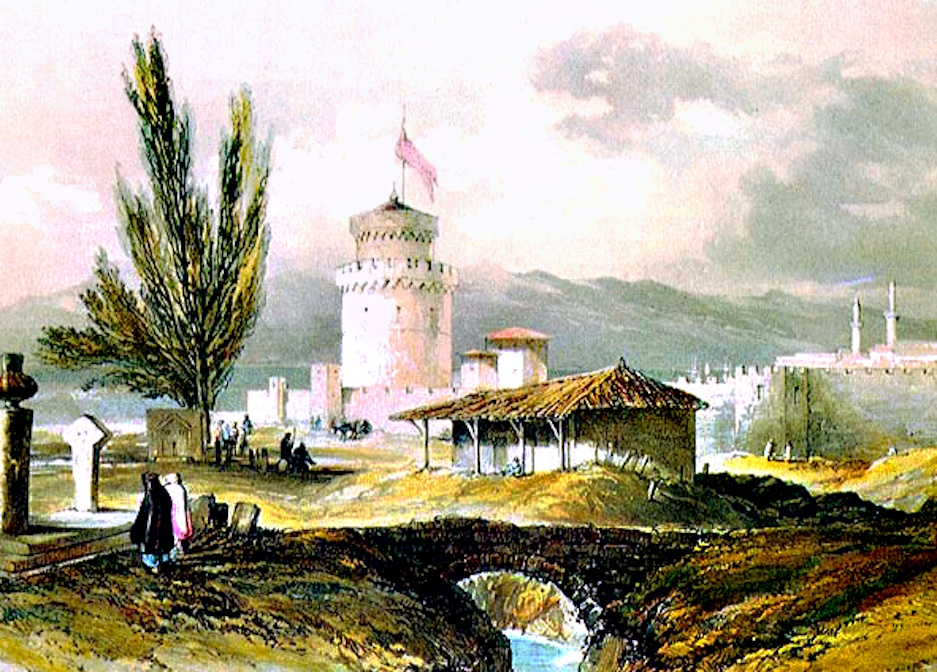 |
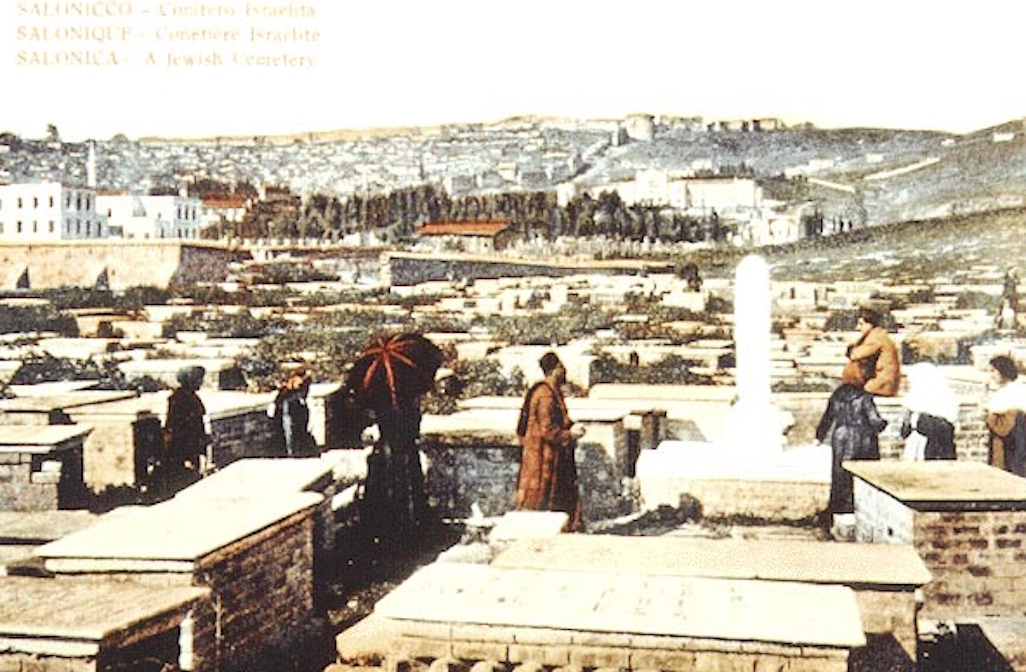 |
Left: The White Tower (Beyaz Kule) or Blood Tower (Kanli Kule) served as an Ottoman prison for four centuries. A painting from the early 19th century also shows the wall that surrounded the tower until 1911.
Right: The Jewish cemetery on a postcard (19th century). Today the University of Thessaloniki stands there.
Soon after the turn of the 15th to 16th century, however, nearly 20,000 Sephardic Jews immigrated to Greece from the Iberian Peninsula following their expulsion from Spain by the 1492 Alhambra Decree. By c. 1500, the number of Christians had grown to 7,986, the Muslims to 8,575, and the Jews to 3,770. In 1519, according to Ottoman archives, the population of Thessaloniki numbered 1,374 Muslim households and 282 bachelors, for a total of 6,870, 1,078 Christian households and 355 bachelors, for a total of about 6,635, and 3,143 Hebrew households with 530 bachelors, for a total of 15,715, 54% of the city's population. Some historians consider the Ottoman regime's invitation to Jewish settlement was a strategy to prevent the Christian population from dominating the city. The city became both the largest Jewish city in the world and the only Jewish majority city in the world in the 16th century. As a result, Thessaloniki attracted persecuted Jews from all over the world.
Thessaloniki was the capital of the Sanjak of Selanik within the wider Rumeli Eyalet (Balkans) until 1826, and subsequently the capital of Selanik Eyalet (after 1867, the Selanik Vilayet). This consisted of the sanjaks of Selanik, Serres and Drama between 1826 and 1912.
With the break out of the Greek War of Independence in the spring of 1821, the governor Yusuf Bey imprisoned in his headquarters more than 400 hostages. On 18 May, when Yusuf learned of the insurrection to the villages of Chalkidiki, he ordered half of his hostages to be slaughtered before his eyes. The mulla of Thessaloniki, Hayrıülah, gives the following description of Yusuf's retaliations: "Every day and every night you hear nothing in the streets of Thessaloniki but shouting and moaning. It seems that Yusuf Bey, the Yeniceri Agasi, the Subaşı, the hocas and the ulemas have all gone raving mad." It would take until the end of the century for the city's Greek community to recover.
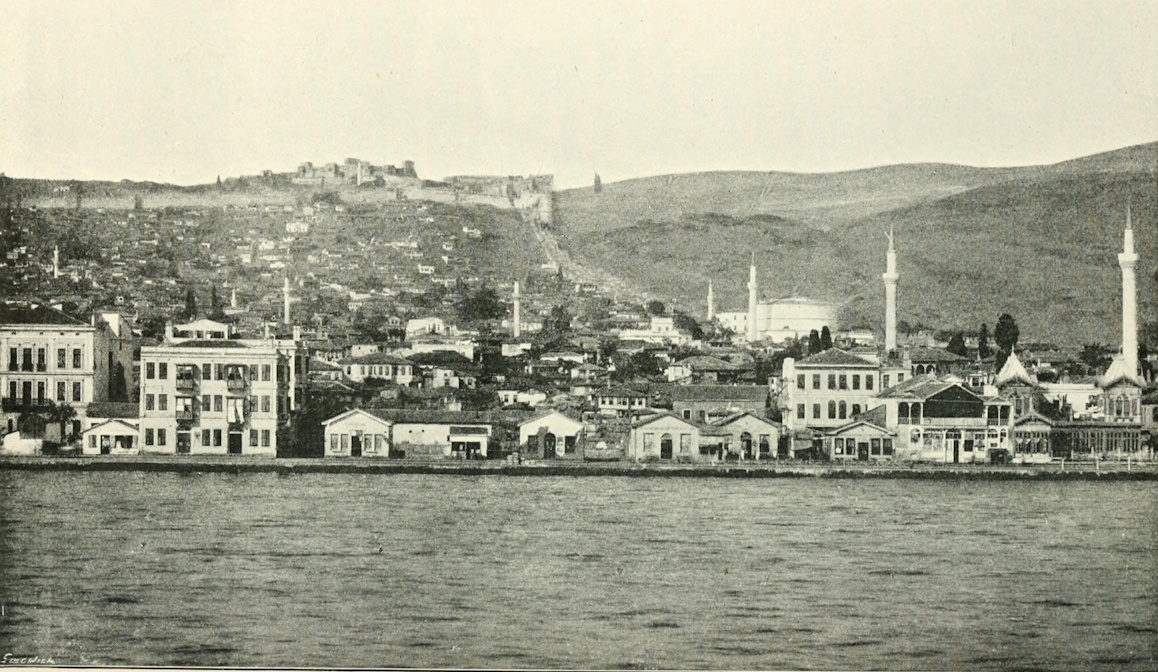 |
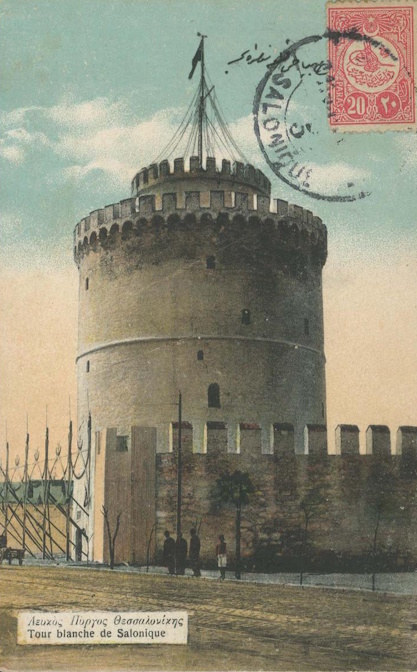 |
Left: City view around 1898, photograph by William Miller (1864–1945).
Right: View of the White Tower around 1912.
Thessaloniki was also a Janissary stronghold where novice Janissaries were trained. In June 1826, regular Ottoman soldiers attacked and destroyed the Janissary base in Thessaloniki while also killing over 10,000 Janissaries, an event known as The Auspicious Incident in Ottoman history. In 1870–1917, driven by economic growth, the city's population expanded by 70%, reaching 135,000 in 1917.
The last few decades of Ottoman control over the city were an era of revival, particularly in terms of the city's infrastructure. It was at that time that the Ottoman administration of the city acquired an "official" face with the creation of the Government House while a number of new public buildings were built in the eclectic style in order to project the European face both of Thessaloniki and the Ottoman Empire. The city walls were torn down between 1869 and 1889, efforts for a planned expansion of the city are evident as early as 1879, the first tram service started in 1888 and the city streets were illuminated with electric lamp posts in 1908. In 1888, the Oriental Railway connected Thessaloniki to Central Europe via rail through Belgrade and to Monastir in 1893, while the Thessaloniki–Istanbul Junction Railway connected it to Constantinople in 1896.
 |
 |
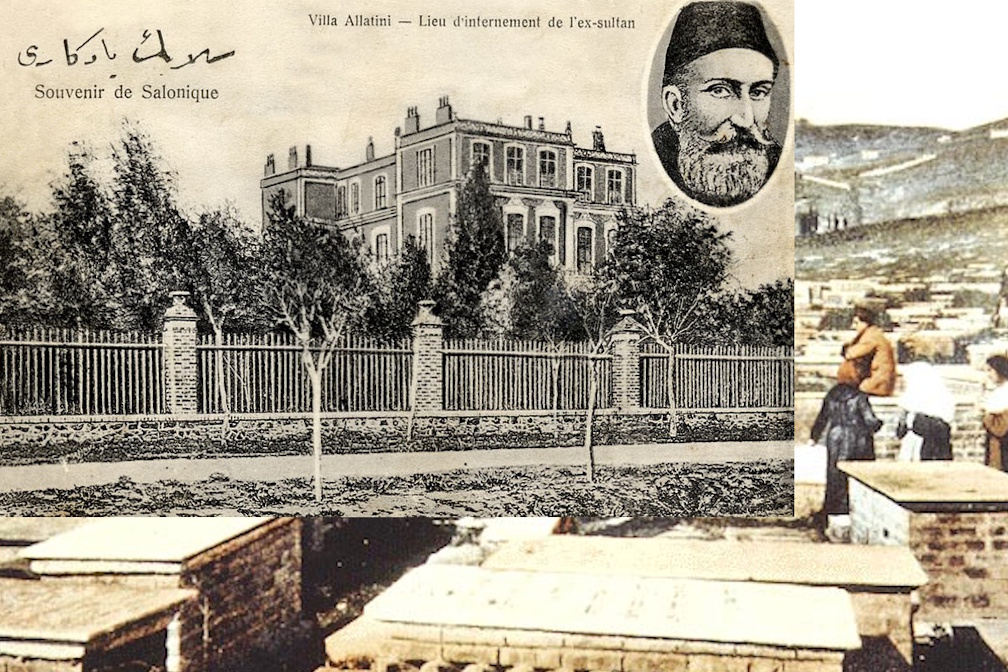
Left: The Allatini estate, owned by the Jewish industrialists of Thessaloniki, housed Sultan Abdul Hamid II in 1909 during his exile in Thessaloniki, which he undertook following the Young Turk movement in Constantinople.
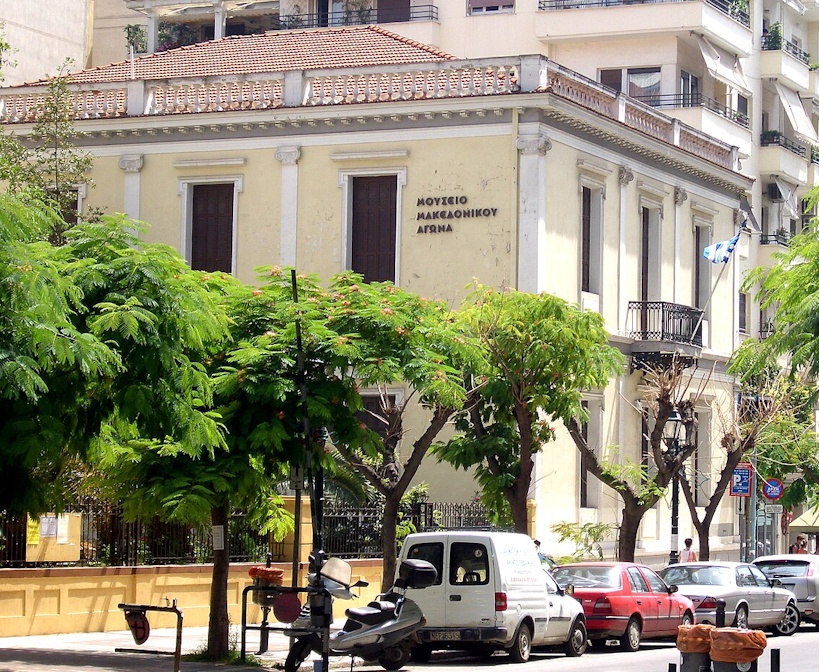
Right: The mansion of the Greek consulate in Thessaloniki, a work by Ernest Ziller. It now houses the Museum of the Macedonian Struggle.
Mustafa Kemal Atatürk, founder of the modern republic of Turkey, was born in Thessaloniki (then known as Selânik in Ottoman Turkish) in 1881. His birthplace on İslahhane Caddesi (now 17 Apostolou Street) is now the Atatürk Museum and forms part of the Turkish consulate complex.
Other notable figures in Turkish and Ottoman history who were born in the city during the Ottoman era include poet and playwright Nâzım Hikmet, Turkey's first female journalist Sabiha Sertel, the Ottoman chronicler Mustafa Selaniki, Turkish patriot Hasan Tahsin (no relation to Hasan Tahsin Pasha), and Young Turk politician Mehmed Cavid Bey.
20th century and beyond
In the early 20th century, Thessaloniki was in the centre of radical activities by various groups; the Internal Macedonian Revolutionary Organization, founded in 1897, and the Greek Macedonian Committee, founded in 1903. In 1903, a Bulgarian anarchist group known as the Boatmen of Thessaloniki planted bombs in several buildings in Thessaloniki, including the Ottoman Bank, with some assistance from the IMRO. The Greek consulate in Ottoman Thessaloniki (now the Museum of the Macedonian Struggle) served as the centre of operations for the Greek guerillas.During this period, and since the 16th century, Thessaloniki's Jewish element was the most dominant; it was the only city in Europe where the Jews were a majority of the total population. The city was ethnically diverse and cosmopolitan. In 1890, its population had risen to 118,000, 47% of which were Jews, followed by Turks (22%), Greeks (14%), Bulgarians (8%), Roma (2%), and others (7%). By 1913, the ethnic composition of the city had changed so that the population stood at 157,889, with Jews at 39%, followed again by Turks (29%), Greeks (25%), Bulgarians (4%), Roma (2%), and others at 1%. Many varied religions were practiced and many languages spoken, including Judeo-Spanish, a dialect of Spanish spoken by the city's Jews.
 |
 |
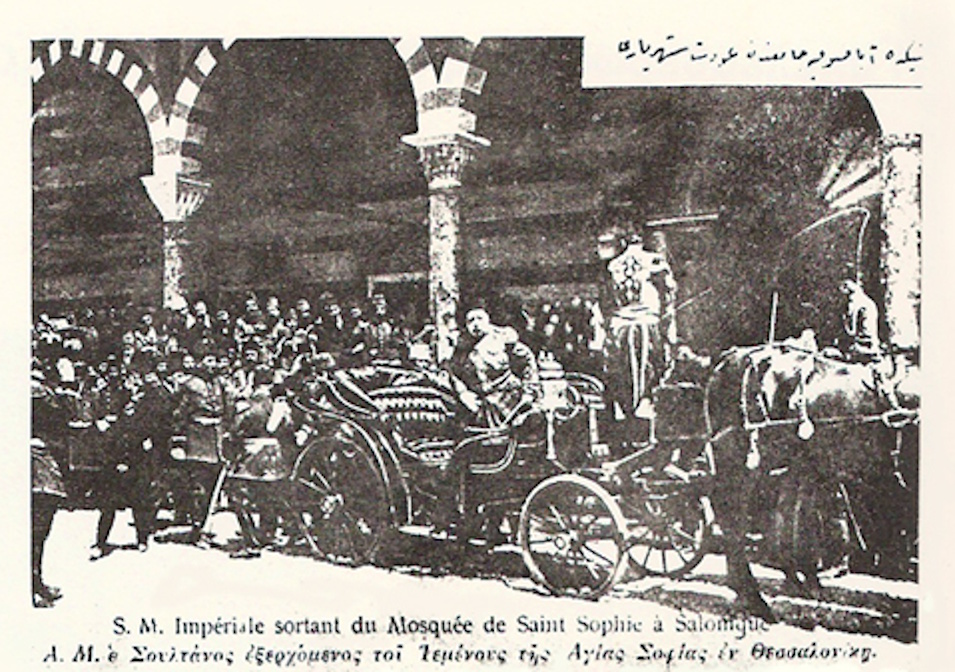
Left: Snapshot of Sultan Mehmet V. Resat's departure after the pilgrimage to Hagia Sophia in Thessaloniki on May 31, 1911.
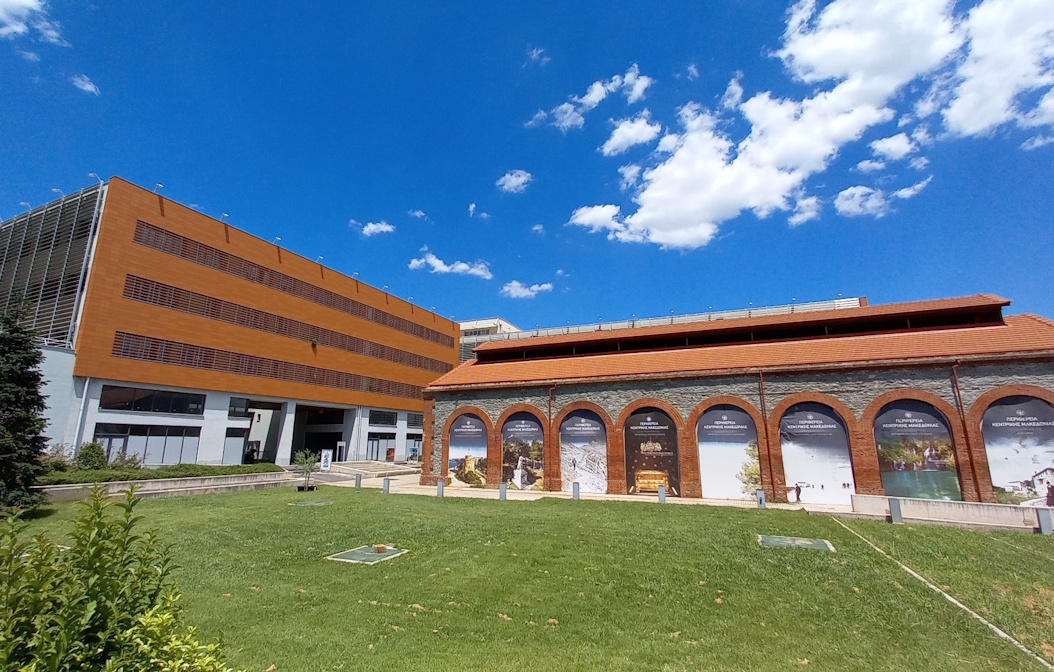
Right: The building of the Central Macedonia region on 26 October Street with the historic gasworks building from 1888.
Thessaloniki was also the centre of activities of the Young Turks, a political reform movement, whose goal was to replace the Ottoman Empire's absolute monarchy with a constitutional government. The Young Turks started out as an underground movement, until finally in 1908, they started the Young Turk Revolution from the city of Thessaloniki, which led to them gaining control over the Ottoman Empire and put an end to the Ottoman sultan's power. Eleftherias (Liberty) Square, where the Young Turks gathered at the outbreak of the revolution, is named after the event. Turkey's first president Mustafa Kemal Atatürk, who was born and raised in Thessaloniki, was a member of the Young Turks in his soldier days and also partook in the Young Turk Revolution.
Balkan Wars and the end of Ottoman rule
As the First Balkan War broke out, Greece declared war on the Ottoman Empire and expanded its borders. When Eleftherios Venizelos, Prime Minister at the time, was asked if the Greek army should move towards Thessaloniki or Monastir (now Bitola, Republic of North Macedonia), Venizelos replied "Θεσσαλονίκη με κάθε κόστος!" (Thessaloniki, at all costs!). With the outnumbered Ottoman Army fighting a rearguard action against well-prepared Greek forces at Yenidje, Bulgarian troops advancing close by, and the Ottoman naval base at Thessaloniki blockaded by the Greek Navy, General Hasan Tahsin Pasha soon realised that it had become untenable to defend the city. The sinking of the Ottoman ironclad Feth-i Bülend in Thessaloniki harbour on 31 October [O.S. 18 October] 1912, although militarily negligible, further damaged Ottoman morale.As both Greece and Bulgaria wanted Thessaloniki, the Ottoman garrison of the city entered into negotiations with both armies separately. Ultimately it was decided to hand over the city to the Greeks, in part because there was a perception on the Ottoman side that the Greek troops would be more lenient towards its residents. Negotiations between the Greek and Turkish delegations were concluded at the village of Topçin on the outskirts of the city. On 8 November 1912 (26 October Old Style), the feast day of the city's patron saint, Saint Demetrius, the Greek Army accepted the peaceful and unconditional surrender of the 25,000-strong Ottoman garrison at Thessaloniki, bringing almost five centuries of Ottoman rule to an end. The Bulgarian army arrived one day after the surrender of the city to Greece and Hasan Tahsin Pasha, commander of the city's defences, told the Bulgarian officials that "I have only one Thessaloniki, which I have surrendered".
After the Second Balkan War, Thessaloniki and the rest of the Greek portion of Macedonia were officially annexed to Greece by the Treaty of Bucharest in 1913. On 18 March 1913 George I of Greece was assassinated in the city by Alexandros Schinas.
World War I, the Great Fire, and population exchange
In 1915, during World War I, a large Allied expeditionary force established a base at Thessaloniki for operations against pro-German Bulgaria. This culminated in the establishment of the Macedonian Front, also known as the Salonika front, and a temporary hospital run by the Scottish Women's Hospitals for Foreign Service being set up in a disused factory. In 1916, pro-Venizelist Greek army officers and civilians, with the support of the Allies, launched an uprising, creating a pro-Allied temporary government by the name of the "Provisional Government of National Defence" that controlled the "New Lands" (lands that were gained by Greece in the Balkan Wars, most of Northern Greece including Greek Macedonia, the North Aegean as well as the island of Crete); the official government of the King in Athens, called in historiography as the "State of Athens", controlled "Old Greece" which was traditionally monarchist. The State of Thessaloniki was disestablished with the unification of the two opposing Greek governments under Venizelos, following the abdication of King Constantine in 1917.On 30 December 1915 an Austrian air raid on Thessaloniki alarmed many town civilians and killed at least one person, and in response the Allied troops based there arrested the German, Austrian, Bulgarian and Turkish vice-consuls and their families and dependents and put them on a battleship, and billeted troops in their consulate buildings in Thessaloniki.
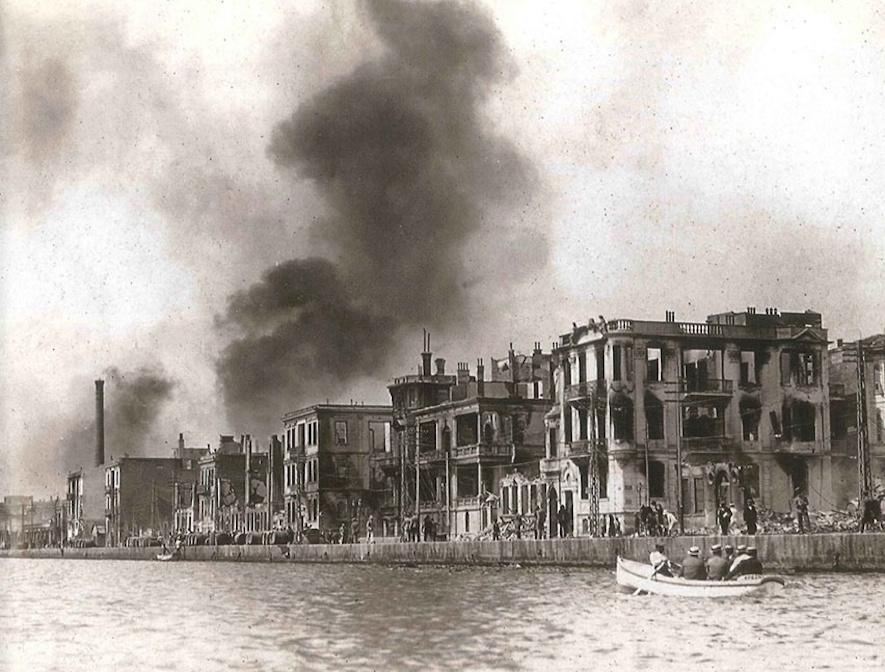
Most of the old centre of the city was destroyed by the Great Thessaloniki Fire of 1917, which was started accidentally by an unattended kitchen fire on 18 August 1917. The fire swept through the centre of the city, leaving 72,000 people homeless; according to the Pallis Report, most of them were Jewish (50,000). Many businesses were destroyed, as a result, 70% of the population were unemployed. Two churches and many synagogues and mosques were lost. More than one quarter of the total population of approximately 271,157 became homeless. Following the fire the government prohibited quick rebuilding, so it could implement the new redesign of the city according to the European-style urban plan prepared by a group of architects, including the Briton Thomas Mawson, and headed by French architect Ernest Hébrard. Property values fell from 6.5 million Greek drachmas to 750,000.
After the defeat of Greece in the Greco-Turkish War and during the break-up of the Ottoman Empire, a population exchange took place between Greece and Turkey. Over 160,000 ethnic Greeks deported from the former Ottoman Empire – particularly Greeks from Asia Minor and East Thrace were resettled in the city, changing its demographics. Additionally many of the city's Muslims, including Ottoman Greek Muslims, were deported to Turkey, ranging at about 20,000 people. This made the Greek element dominant, while the Jewish population was reduced to a minority for the first time since the 16th century.
This was part of an overall process of modern Hellenization, which affected nearly all minorities within Greece, turning the region into a hotspot of ethnic nationalism.
 |
 |
Left: The great fire of 1917 ... shortly after it broke out.
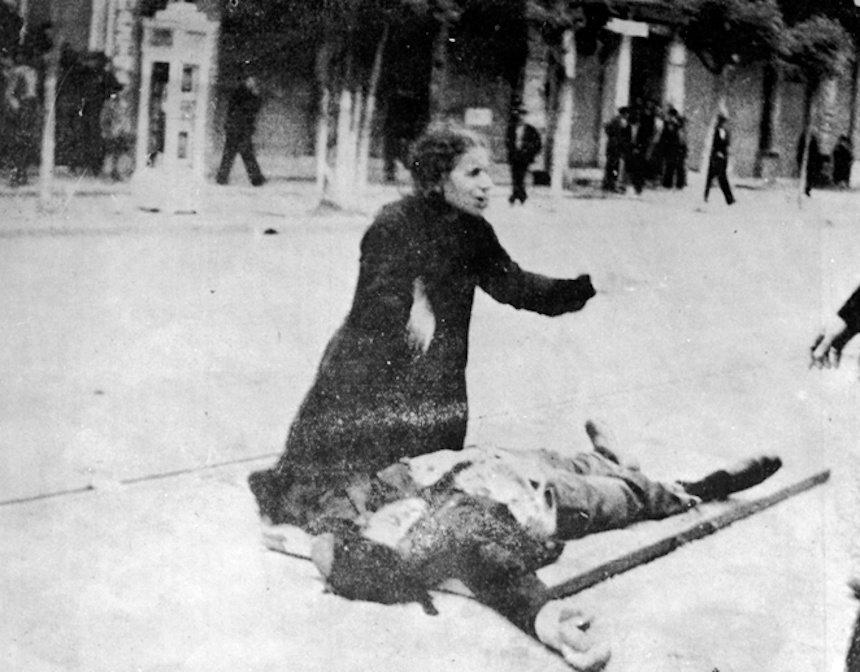
Right: May 9, 1936: Tasos Tasou's mother mourns her son, the first casualty of the bloody suppression of the Thessaloniki tobacco workers' demonstration.
World War II
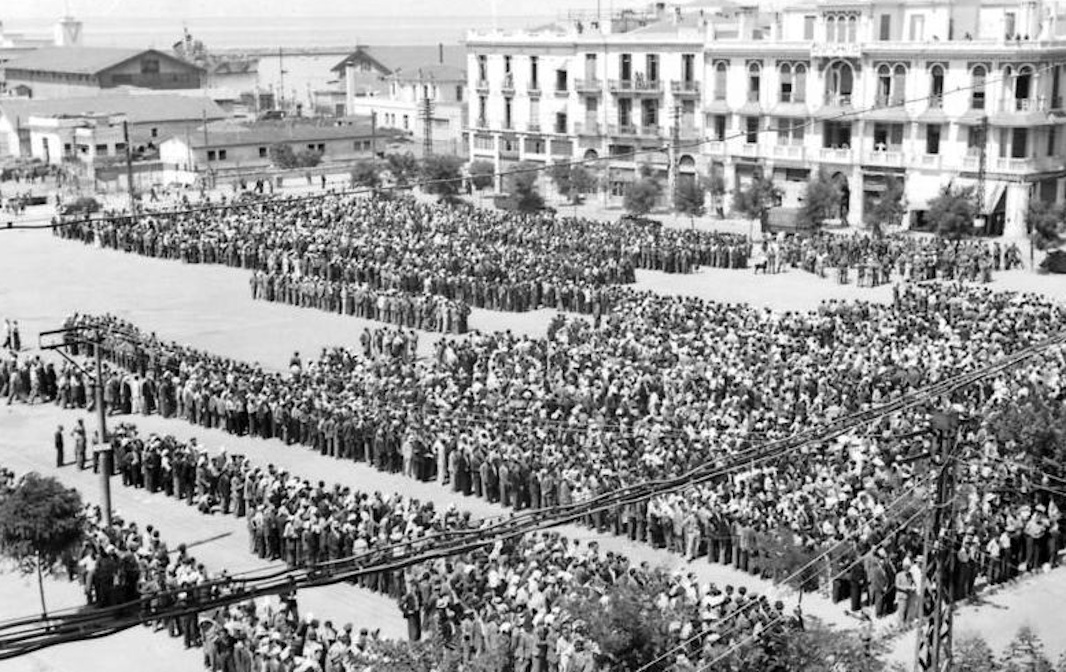
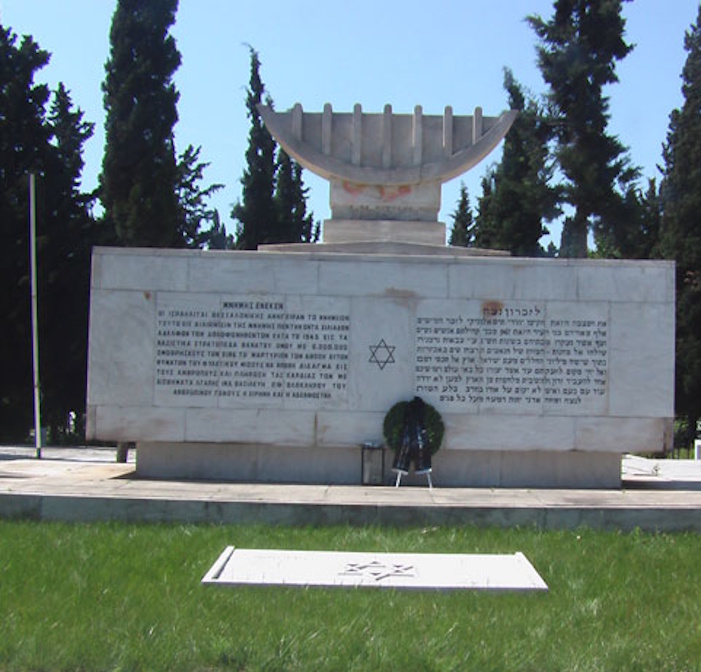
During World War II Thessaloniki was heavily bombarded by Fascist Italy (with 232 people dead, 871 wounded and over 800 buildings damaged or destroyed in November 1940 alone), and, the Italians having failed in their invasion of Greece, it fell to the forces of Nazi Germany on 8 April 1941 and went under German occupation. The Nazis soon forced the Jewish residents into a ghetto near the railroads and on 15 March 1943 began the deportation of the city's Jews to Auschwitz and Bergen-Belsen concentration camps. Most were immediately murdered in the gas chambers. Of the 45,000 Jews deported to Auschwitz, only 4% survived.Speaking in the Reichstag, Hitler claimed that the intention of his Balkan campaign was to prevent the Allies from establishing "a new Macedonian front", as they had during WWI. The importance of Thessaloniki to Nazi Germany can be demonstrated by the fact that, initially, Hitler had planned to incorporate it directly into Nazi Germany and not have it controlled by a puppet state such as the Hellenic State or an ally of Germany (Thessaloniki had been promised to Yugoslavia as a reward for joining the Axis on 25 March 1941).
As it was the first major city in Greece to fall to the occupying forces, the first Greek resistance group was formed in Thessaloniki (under the name Ελευθερία, Elefthería, "Freedom") as well as the first anti-Nazi newspaper in an occupied territory anywhere in Europe, also by the name Eleftheria. Thessaloniki was also home to a military camp-converted-concentration camp, known in German as "Konzentrationslager Pavlo Mela" (Pavlos Melas Concentration Camp), where members of the resistance and other anti-fascists were held either to be killed or sent to other concentration camps. In September 1943, the Germans established the Dulag 410 transit camp for Italian Military Internees in the city. On 30 October 1944, after battles with the retreating German army and the Security Battalions of Poulos, forces of ELAS entered Thessaloniki as liberators headed by Markos Vafiadis (who did not obey orders from ELAS leadership in Athens to not enter the city). Pro-EAM celebrations and demonstrations followed in the city. In the 1946 monarchy referendum, the majority of the locals voted in favor of a republic, contrary to the rest of Greece.
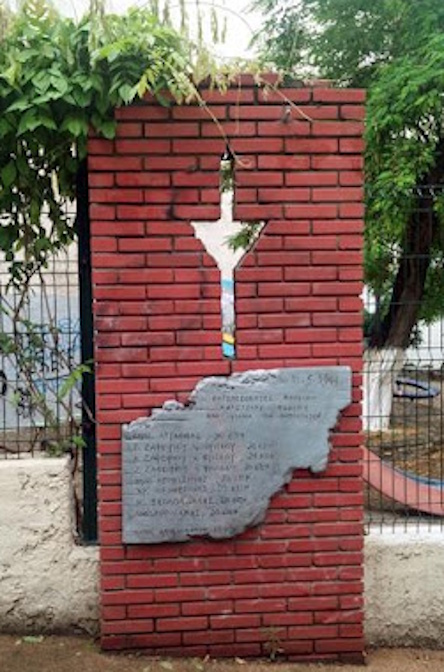
On May 11, 1944, eight young resistance fighters were executed by the Nazis in Kastri: Girgos Zafiriou, 26 years old, Zafiris Zafiriou, 20 years old, Michalis Leontsinis, 26 years old, Christos Leontsinis, 20 years old, Kostas Xepapadakiw, 20 years old, Anastasios Aplaidis, 30 years old and Andreas Chorozakis, 20 years old.
 |
 |
Left: July 11, 1942: Meeting of Jews on Freedom Square.
Right: Memorial near Kastri/Xirokrini
Post-war: contemporary Thessaloniki
After the war, Thessaloniki was rebuilt with large-scale development of new infrastructure and industry throughout the 1950s, 1960s and 1970s. Many of its architectural treasures still remain, adding value to the city as a tourist destination, while several early Christian and Byzantine monuments of Thessaloniki were added to the UNESCO World Heritage list in 1988. In 1997, Thessaloniki was celebrated as the European Capital of Culture, sponsoring events across the city and the region. Agency established to oversee the cultural activities of that year 1997 was still in existence by 2010. In 2004, the city hosted a number of the football events as part of the 2004 Summer Olympics.Today, Thessaloniki has become one of the most important trade and business hubs in Southeastern Europe, with its port, the Port of Thessaloniki being one of the largest in the Aegean and facilitating trade throughout the Balkan hinterland. On 26 October 2012 the city celebrated its centennial since its incorporation into Greece. The city also forms one of the largest student centers in Southeastern Europe, is host to the largest student population in Greece and was the European Youth Capital in 2014. Infrastructure improvements came in the 2020s with the upgrade and expansion of Thessaloniki Airport in 2021 and the opening of Thessaloniki Metro in 2024.
 |
 |
Left: Holocaust Memorial in the Thessaloniki cemetery.
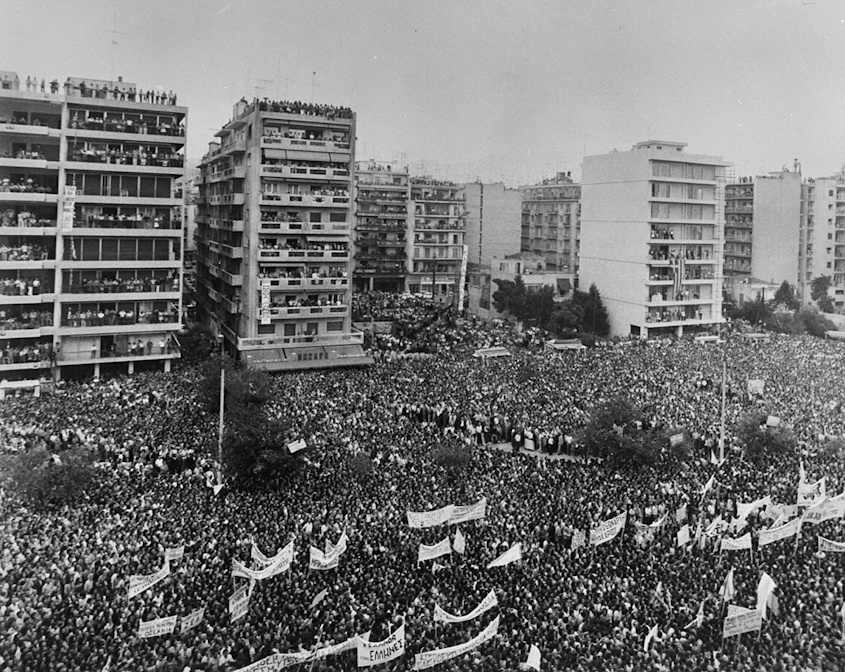
Right: People on the occasion of Konstantinos Karamanlis' visit to Thessaloniki on September 4, 1974.
Other districts of Thessaloniki Municipality
In the Municipality of Thessaloniki, in addition to the historic centre and the Upper Town (Ano Polis), are included the following districts: Xirokrini, Dikastiria (Courts), Ichthioskala, Palaios Stathmos, Lachanokipoi, Behtsinari, Panagia Faneromeni, Doxa, Saranta Ekklisies, Evangelistria, Triandria, Agia Triada-Faliro, Ippokrateio, Charilaou, Analipsi, Depot and Toumba.Τhe Ηistoric Ψentre
The city of Thessaloniki has a fairly extensive center where most of the shops, public facilities, tourist attractions, and recreational areas are concentrated. <π> The area can be defined northwest of Democracy Square (also known as Vardari Square), which has traditionally been the city center and the starting point for measuring distances in Thessaloniki. To the southeast, it borders the university campus, the 3rd Army Corps, and the new City Hall; to the southwest, the coastal road Leoforos Nikis; and to the northeast, Agios Dimitrius Street. The historic center of Thessaloniki is divided into the following districts: Vardaris, Ladadika, Ano Ladadika, Frangon, Kapani, Aristotelous, Diagonios, Navarinou, Rotunda, Hagia Sophia, Ancient Market Square, Hippodrome, and White Tower.The main traffic arteries are the streets Tsimiski, Egnatia, Nikis, Mikis Theodorakis Manastiriou, Agiou Dimitriou, Dodekanisou, Ethnikis Aminas, Paŭlou Mela, Diikitiriou, Ioannidou, Paöaiom Patron Germanou, Venuzelou, Ionos Dragoumi Ermou and Alexandrou Svolon.
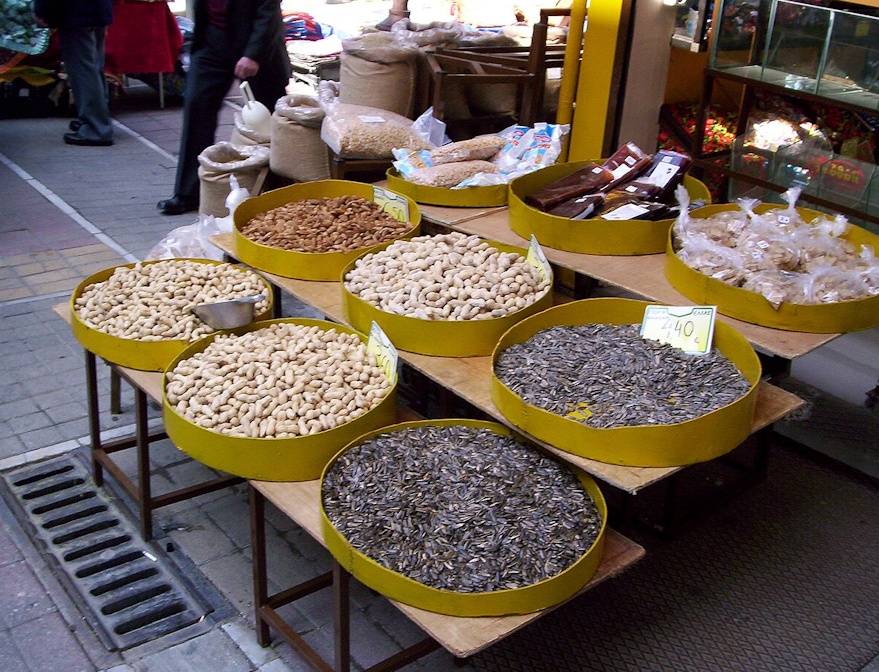
In the second half of the 20th century, the center of Thessaloniki underwent significant expansions to the northeast and southeast. While the central market was formerly located in the Vardar area and extended to the canal (Vlali Market), it is now situated between the new train station and CH.A.N.TH. Square (Πλατεία της Χ.Α.Ν.Θ.).
The Upper Town (Ano Polis)
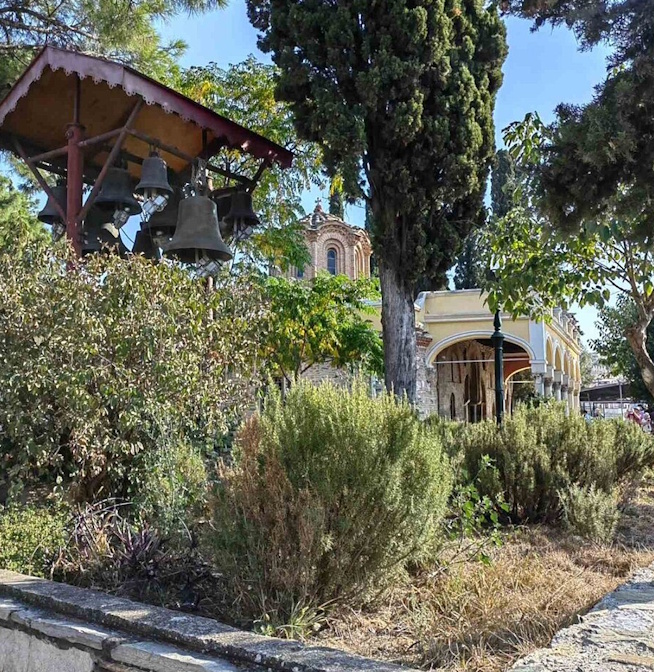
The Upper Town (Άνω Πόλης), which survived the great fire of 1917, was declared a protected traditional district in 1980. It is located in the northernmost and highest part of the Old City. The district begins at the northern end of Olympiados Street and extends north to the walls of the Acropolis, and west and east to the Byzantine walls, which are almost completely preserved in this area. The districts of the Upper Town include Tsinari, Vlatadon, Taxiarches, Koule Kafe, Pprtara, Kastra, Eptapyrgo (Acropolis), and Diikitiriou.Although the area has not been investigated through archaeological excavations, it is almost certain that it was uninhabited, or at least not significantly inhabited, during the Hellenistic, Roman, and Byzantine periods. Residential quarters were created during the Turkish occupation, and the area became densely populated in the last years of the 19th century, particularly after the arrival of refugees from the Asia Minor catastrophe.
 |
 |
Left: Central Market
Right: The Vlatadon Monastery in the upper town
This area contains important monuments of Thessaloniki, such as the city walls with the Byzantine acropolis in Eptapyrgio, the Alysseus Tower (Trigoniou), the Church of Saint David (Latomou Monastery), the Church of Saint Nicholas the Orphan, the Archangel Church, the Vlatadon Monastery, the Church of Saint Catherine, the Church of the Prophet Elias, the Church of Panagia Chalkeon, located near the ancient Agora at the intersection of Egnatia and Chalkeon streets, an area where coppersmiths used to have their workshops, the Byzantine bath in Krispou Square at Koule Kafe, the Alatza Imaret in Kassandrou Street, the Ottoman Moussa Baba Turbes in Terpsitheas Square, and the Tsinari Fountain.
Apart from these monuments, however, the old, traditional cityscape with its narrow cobblestone streets, dead ends, small clearings and squares, and above all the buildings of Macedonian architecture, unique in their simplicity, functionality and elegance, with their characteristic projections (Sachnisi, the “Solarium” of the Byzantines) and covered balconies (“Hagiatia”), but also houses with Ottoman architectural influences, have been preserved in the area of the upper town in many parts. An excellent example of the residential structure of the upper town are the Kastroplekta houses, those built during the population movements of the first decades of the 20th century (the Asia Minor Catastrophe and population exchange). These houses, built against the Byzantine walls, were erected by refugees from Asia Minor and bear witness to the rapid, improvised settlement of refugees in the city. Due to the lack of space, they built small, single-story houses directly against the walls to create shelter.
Xirokrini
Xirokrini takes its name from the district of the same name in Constantinople, as refugees from Constantinople, Asia Minor, Eastern Thrace and Eastern Rumelia were the first settlers of the area after the Asia Minor catastrophe of 1922 and the population exchange of 1923–1924.The area was an important center of worship in early Christian and Byzantine times, and until recently three early Christian churches were excavated that may be associated with the martyrdom and memory of Saint Nestor or the three martyred sisters Agapi, Irene and Chionia, who also suffered martyrdom there.
Today, the Byzantine fountain of Xirokrini is preserved, as are the foundations of the early Christian basilica of Xirokrini. There are also groves and parks such as the Agia Paraskevi Grove with the historic church of Agia Paraskevi Xirokrini, built in 1897, and Alexandros Galopoulou Square, among others.
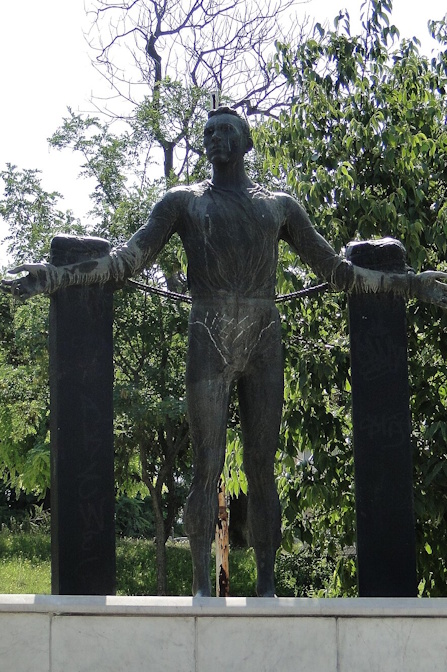
The area also contains the statue of Georgios Sainovich Ivanov, at the intersection of Agios Dimitriou Street and Mikis Theodorakis Avenue. Georgios Ivanov was one of the most important resistance fighters of the Allies against the Axis powers.
The area of the Old Railway Station
In the area of the Old Railway Station (Palaios Stathmos) began the construction of the Holocaust Museum of Greece. In this area are located the Railway Museum of Thessaloniki, the Water Supply Museum and large entertainment venues of the city, such as Milos, Fix, Vilka (which are housed in converted old factories). The Thessaloniki railway station is located on Monastiriou street.
Toumba
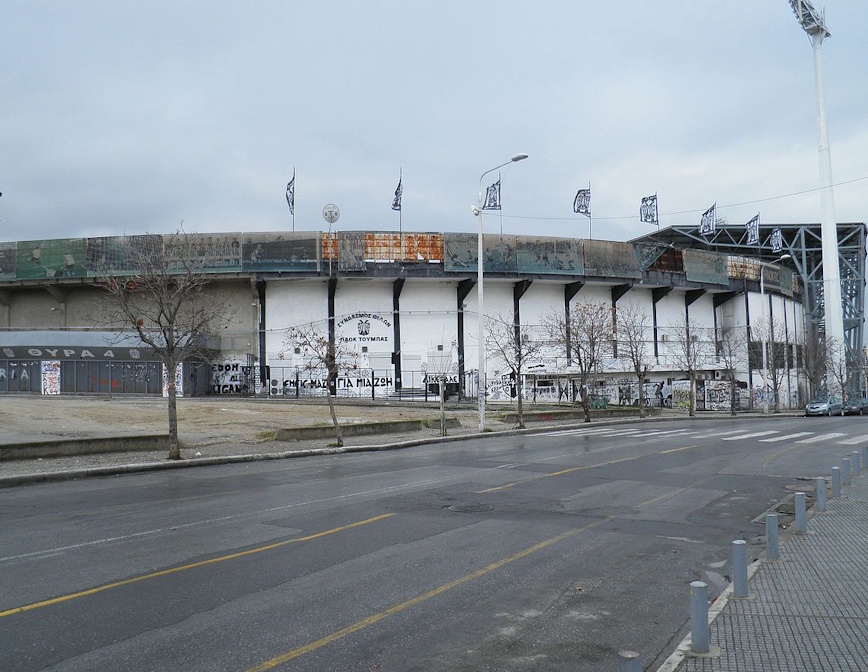
Other extended and densely built-up residential areas are Charilaou and Toumba, which is divided into "Ano Toumpa" and "Kato Toumpa". Toumba was named after the homonymous hill of Toumba, where extensive archaeological research takes place. It was created by refugees after the 1922 Asia Minor disaster and the population exchange (1923–24). On Exochon avenue (Rue des Campagnes, today Vasilissis Olgas and Vasileos Georgiou Avenues), was up until the 1920s home to the city's most affluent residents and formed the outermost suburbs of the city at the time, with the area close to the Thermaic Gulf, from the 19th-century holiday villas which defined the area.
 |
 |
Left: Statue of von Georgi Sainowitsch-Iwanow
Right: Toumba Stadium, home of the PAOK football club